Philips today announced it has received FDA 510(k) clearance for EchoNavigator R5.0 with DeviceGuide, an AI-powered software solution that assists physicians while repairing leaking mitral valves through a minimally invasive approach.
DeviceGuide was developed in close collaboration with Edwards Lifesciences, aligning Philips’ imaging and AI expertise with Edwards’ expertise in valvular heart therapy development. Together, the companies have innovated image guidance of the mitral transcatheter edge-to-edge repair (M-TEER) workflow to make these complex minimally invasive heart valve repair procedures more intuitive and streamlined.
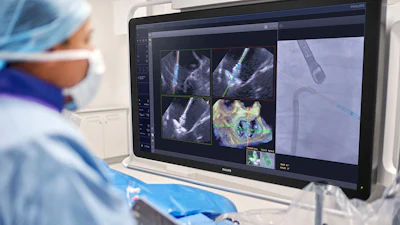
Built on Philips’ EchoNavigator echo-fluoro fusion technology, which combines live echocardiography images from Philips EPIQ CVxi cardiovascular platform with live X-ray images from Philips Azurion image-guided therapy system, DeviceGuide brings real-time AI guidance directly into the procedure room.
The software’s AI algorithm automatically tracks and visualizes the Edwards PASCAL Ace mitral valve repair device, combining live ultrasound and X-ray images into a single, integrated view. This helps clinicians navigate and position the device with greater clarity and confidence.
“The AI software serves as an assistive tool; the physician always remains in control. This isn’t about replacing expertise – it’s about amplifying it,” explains Dr. Atul Gupta, Chief Medical Officer Diagnosis & Treatment at Philips. “By embedding AI into the procedure, DeviceGuide gives physicians an extra pair of eyes, helping them treat more patients safely and confidently.”
In developing DeviceGuide, Philips and Edwards worked closely with investigational sites in Europe and the U.S., including a team at the Structural Heart and Valve Center at NewYork-Presbyterian/Columbia University Irving Medical Center, led by interventional cardiologist Susheel Kumar Kodali, MD, director, and Rebecca T. Hahn, MD, director of interventional echocardiography.