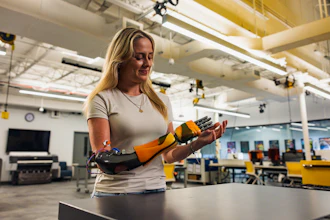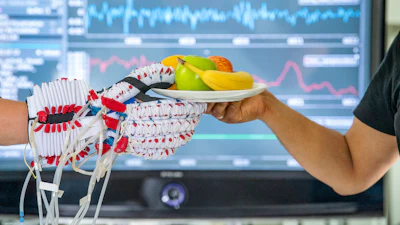
The Technical University of Munich (TUM) has developed a soft, pneumatic glove that restores the ability of people with paralyzed hands to grasp objects. To achieve this, researchers at the TUM Chair of Cognitive Systems use electrical signals from the forearm muscles to reliably predict when a person intends to grasp an object. The invention could one day help people whose hands have been paralyzed as a result of accidents or neurological disorders.
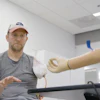
The “soft-hand exoskeleton” consists of a fabric glove developed by the researchers, with air cushions attached to its outer surface. The air cushions are inflated through a total of 13 tubes, providing targeted support for the hand movements needed to hold a plate or grasp a glass, fork or spoon. The air-filled cushions allow each finger to be bent and straightened individually while also rotating the wrist, enabling objects to be held securely in the hand.
To determine when a person intends to grasp an object, the researchers measure muscle activity in the forearm. Sensors attached to the forearm capture electrical signals, which are analyzed using machine learning to reliably determine the intended movement. “To prevent objects from being dropped accidentally, we use additional motion sensors to detect transport movements and keep the exoskeleton’s grip securely closed throughout the movement,” says researcher Nicolas Berberich.
A soft-hand exoskeleton that anyone can afford
“Our solution is intelligent in two ways,” explains his colleague, Dr. John Nassour. “On the one hand, we’ve developed a highly reliable method of predicting grasping movements by inferring intentions from signals with 97% reliability. On the other hand, with our glove, we’ve developed hardware that optimally supports the intended movements.” Another advantage is that Nassour sewed the glove himself, and the required fabric costs very little. At first glance, the glove doesn’t look high-tech, but it can be used by many people with paralysis. “We’ve found a solution that anyone can afford but still works very well,” says Prof. Gordon Cheng, director of the Institute for Cognitive Systems. Close collaboration with a patient with amyotrophic lateral sclerosis (ALS) was crucial to the development of the soft-hand exoskeleton.
People with ALS gradually lose control of their movements. This is because the nerve cells responsible for skeletal muscle contraction are damaged and continue to degenerate. At the start of the project, the patient already had very little control over his hands, but was still able to move the first thumb joint. The researchers based their experiment on the strongest signals generated by the thumb muscles. To record this electromyogram, they attached a sensor to the forearm that detects the strongest signals from the flexor pollicis longus muscle as soon as it is moved. These signals trigger the inflation of the glove’s air cushions.
ALS patient picks up a fork for the first time in four years
Despite very weak signals, the system recognized the patient’s intention in 9 out of 10 cases. He was able to reach for objects, hold a fork for the first time in four years, and pick up small cubes and drop them into a container. A video game also contributed to this success. The patient had to make a character jump using only the movement of his thumb joint. The researchers found that just five minutes are enough to greatly improve the patient’s ability to grasp objects. “This patient has shown us that our soft-hand exoskeleton can support him despite one of the most severe neurological disorders,” says Prof. Cheng.
“We are now adapting the concept for other patients, such as stroke survivors,” the researcher adds. A key finding of the current study is that people with severe impairments can regain the ability to grasp objects more effectively with the help of the glove. Neurologist Prof. Tobias Wächter from the partner institution Klinik Passauer Wolf is convinced of the potential of the new specialized glove: “In principle, this glove can help people with flaccid paralysis, including, for example, people who have sustained peripheral nerve damage following motorcycle or bicycle accidents, or patients with polyneuropathy,” says Prof. Wächter.