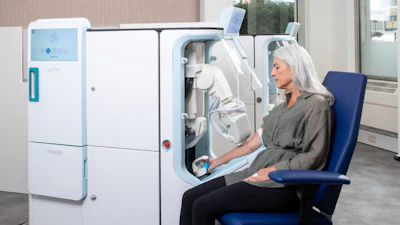
The FDA has granted De Novo authorization for Aletta, Vitestro's Autonomous Robotic Phlebotomy Device (ARPD). The company said the authorization marks the first U.S. regulatory clearance for a fully autonomous blood draw system and establishes a new device classification for the category.
The device guides the patient to position their arm, after which the patient or supervisor presses a button to start the blood draw. The Aletta then uses near-infrared light and Doppler ultrasound to locate a suitable vein and tell it apart from arteries. If no appropriate vein is found, the device will not attempt the procedure.
Once a vein is identified, the Aletta proceeds through the remaining steps on its own: applying a tourniquet, preparing the skin, inserting and disposing of the needle, changing collection tubes and placing a bandage. The supervising phlebotomist confirms that collection tubes are filled in the correct order and verifies that all tubes are adequately full following the procedure.
Aletta is designed to support phlebotomy departments by performing routine diagnostic blood draws, helping address staffing challenges, standardizing quality and enhancing the overall patient experience. The device is already CE-marked and in clinical and pre-commercial use across Europe.
Vitestro said it will now advance manufacturing scale-up, commercial infrastructure and phased rollout planning ahead of a U.S. market launch, working alongside its U.S.-based clinical and market research collaborators.
As part of this effort and prior to U.S. commercial availability, the company plans a U.S. multicenter clinical trial to validate the performance and safety of Aletta, generating clinical evidence to support the adoption of automated phlebotomy as a scalable solution for U.S. hospital and outpatient blood draw centers. Aletta will be first commercially deployed in Europe, and the U.S. will follow.