Advances in surgical robotic technology are enabling broader adoption across hospitals, surgical centers and other settings. As this technology is implemented across a range of facilities with different economic and operational requirements, surgical instrument developers must design robotic surgical instruments to accommodate different procedure volumes, reprocessing capabilities, inventory models and cost constraints.
Traditionally, reusable instruments can reduce recurring cost and waste, but they also require validated reprocessing procedures and resistance to harsh sterilizing chemicals. Fully disposable instruments avoid reprocessing demands but can, in some cases, introduce additional waste and cost burden.
A component-level design approach offers another option by allowing engineers to optimize both the instrument materials and architecture depending on specific functional requirements. By defining where single-use, limited-use and reusable elements make the most sense, designers can align each component’s material, geometry and validation requirements with its intended service life. This selective approach can reduce reprocessing burden without compromising the predictable mechanical response and the clinical safety profile required of a robotic surgical instrument.
The instrument still has to feel precise
A component-level design approach is only effective when the instrument delivers the controlled response required for the clinical procedure. Robotic instruments need to articulate through tight geometries, transfer torque over distance and operate through small access points. That performance may depend on cables, jackets, seals, tubing, molded interfaces and flexible layers working together within tight dimensional limits. Because surgeons interact through a robotic platform, "precision feel" is best understood as a predictable response. Each command should produce predictable distal-end motion without excessive lag, play or variation.
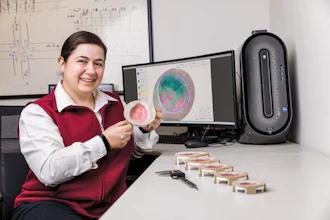
 Lubrizol employee performs an assembly operation during the manufacturing process of a medical device component.Lubrizol
That response is created by the complete mechanical system. Friction in a cable jacket can increase actuation force, compression set in a seal can change resistance over time, and dimensional variation in an access component can affect how smoothly the instrument moves. As a result, material selection and component design can influence how consistently force and motion are transmitted to the distal working end of the instrument.
Define the service life, then design to it
Single-use or limited-use designs can provide greater value when repeated handling and sterilization create additional cost, operational burden, or concerns about long-term performance consistency. A defined service life or a targeted procedure cost gives engineers a way to put boundaries around that variation. The design team can set clear requirements for each component, including expected procedures, actuation cycles and sterilization exposures, then validate performance through the full expected instrument life cycle and required economics.
Thermoplastic polyurethane (TPU) can be a strong fit for single-use designs because its properties can be tailored to deliver the flexibility, durability, friction and processing characteristics required for a specific component without necessarily designing for repeated reprocessing. It can also support limited-use and reusable applications where the material and device architecture are appropriate.
Basic material data, however, can only narrow the options. The ultimate design decision has to be made at the component and assembly level. Properties such as durometer, modulus and tensile strength can guide selection, but may not fully capture how processing history, part geometry , contact pressure or additives will affect the finished interface. For example, a low-friction additive may improve actuation but create bonding or handling challenges during assembly or construction. Understanding those interactions early helps the design team align material specifications with the functional requirements of the instrument assembly and determine which trade-offs matter most.
Designing components that must withstand reprocessing and disinfection adds another layer of complexity because its effects can accumulate over the intended service life of the component. A material that performs well after a single sterilization cycle may not retain the same surface, adhesion or mechanical behavior after repeated cleaning, disinfection and sterilization. Materials that maintain their physical integrity and performance after repeated exposure to reprocessing chemistries including detergents, acids, aldehydes, and peroxides may provide design advantages for components intended to undergo multiple reprocessing cycles.
 Engineer utilizes design software to develop and refine component tooling.Lubrizol
With a well-defined set of component performance targets, the next step is to develop a test plan that reflects the component’s full processing, assembly, sterilization, reprocessing and intended service life.
Linking service life to validation
The most effective evaluation framework follows the complete component and instrument life cycle.
- Define the use case and model. Establish the procedure, expected service life and conditions the component will encounter. Consider the procedure economics, reimbursement models and facility requirements to help define an instrument architecture aligned with the intended healthcare setting.
- Translate the use case into requirements. Specify the forces, motion, friction, sealing or dimensional performance the component must maintain throughout its intended service life.
- Account for the full production history. Include processing, assembly, mechanical interfaces, sterilization, and reprocessing targets that may influence long-term performance.
- Test the finished interface. Evaluate the processed and assembled component under representative conditions through the full intended service life.
This sequence shows whether selective disposability can reduce reprocessing and ownership burden while maintaining performance throughout the instrument’s intended service life. Whether an instrument is used once or twenty times, its response still must remain consistent through every procedure. Materials experts can help teams connect those performance requirements to the right material, processing and validation strategy early in development.