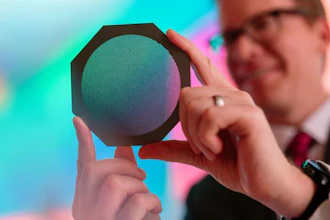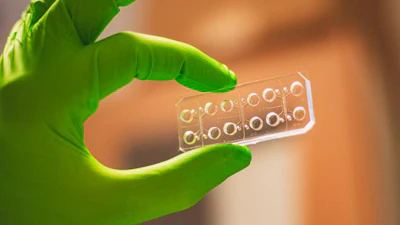
On an organ-on-a-chip researchers can now explore how tumours grow and interact with their surroundings. The chip, a small plate where cancer cells, nerves and blood vessels grow, was developed by researchers at Linköping University, Sweden, in collaboration with colleagues at Politecnico di Milano in Italy. It is described in an article published in the journal Proceedings of the National Academy of Sciences (PNAS).
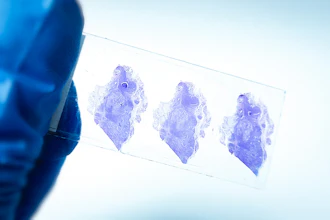
A tumor consists of more than just cancer cells. In the body, solid tumors grow in close interaction with blood vessels, nerves and the surrounding tissue. To replicate basic organ functions outside the body the technology known as organ-on-chip is used. Researchers have now developed such a model of head and neck cancer and demonstrated that the concept works. The entire system fits on a plate roughly the size of a postage stamp.
The model enables researchers to study complex interactions under highly controlled conditions.
“Rather than having to carry out research on animals or test potential drugs in humans, we want to be able to carry out tests in a single microsystem in the laboratory. If we want to understand why a tumor grows, spreads, causes pain or resists treatment, we need models that can replicate the interactions between the tumor and its surroundings,” said Pierfrancesco Pagella, Senior Associate Professor at Linköping University, who led the study published in PNAS.
To replicate interactions in the body, the researchers developed the model in three steps. In the body, cells are immersed in a network of proteins and carbohydrates known as the extracellular matrix, or ECM. The researchers developed a material designed to mimic the ECM, based on hyaluronic acid, collagen and laminins, all substances that are key component of the body’s ECM. They found that ECM composition changed radically the behavior of cancer cells and influenced their response to chemotherapy, indicating that the choice of ECM is an important factor in models that try to imitate human disease.
The researchers then added blood vessel-like structures to their organ-on-chip. Blood vessels are important for tumor growth because they supply cells with oxygen and nutrients. They are also the most common route by which tumors spread to other parts of the body. In addition, anticancer medicines are transported to tumors through the bloodstream.
“We saw that the cancer cells responded to the nearby blood vessel, moved rapidly towards it and invaded it, which is the first step in tumor spread. However, the cells behaved very differently depending on the material surrounding them,” said Pagella.
The researchers then used the blood vessel structure on the chip to administer cisplatin, a medicine commonly used to treat this type of cancer. Here too, the type of ECM material had an impact on how effectively cisplatin killed the cancer cells.
To complete the organ-on-chip model, the researchers used stem cells to recreate trigeminal ganglia, the starting point of the nerves that are involved in sensation and pain in the mouth and throughout the face. Within a few days, the nerves had grown around the tumors.
“In our three-dimensional system, we saw that tumors in contact with nerves were less likely to invade blood vessels, but at the same time grew larger. Our model enables us to study nerves as an active component of the tumor microenvironment. This is particularly interesting in head and neck cancer, where nerves are involved both in regulating tumor behavior and aggressiveness, and in cancer-related pain,” said Pagella.
The researchers behind the study believe that their organ-on-chip model could be adapted to other solid tumor types in which interactions with surrounding structures and tissues are important. Besides supporting studies that increase our understanding of how cancer behaves and is affected by its surroundings, the method could eventually prove useful for applications such as drug screening and testing treatment response.
The study received funding from, among others, the Swedish Research Council, the Knut and Alice Wallenberg Foundation, the European Research Council (ERC) and the Swedish Foundation for Strategic Research (SSF). The organ-on-chip technology was developed in collaboration with MiMic Lab at Politecnico di Milano, led by Professor Marco Rasponi, Chair of the European Organ-on-Chip Society.