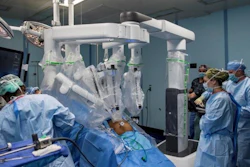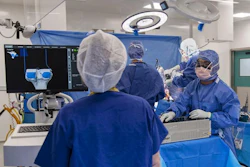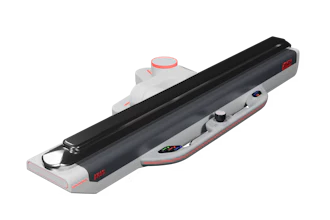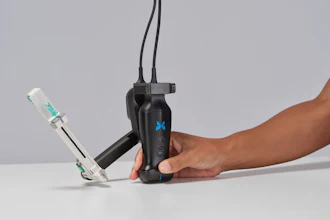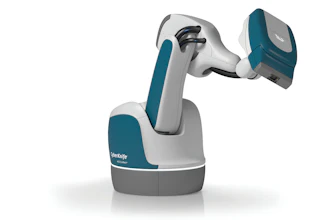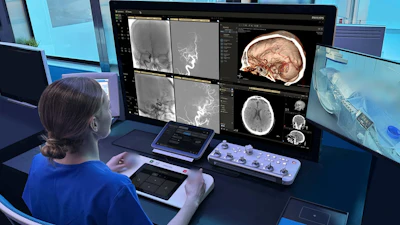
Philips said it has received an up to $33.7 million award under the Advanced Research Projects Agency for Health (ARPA-H) to advance AI-enabled robotic procedure automation for stroke care. Working with Johns Hopkins University, Boston University, and Dr. J Mocco of Weill Cornell Medicine, Philips will develop technologies for remote-assisted and increasingly automated endovascular procedures, helping expand access to advanced stroke care.
The company is integrating imaging, robotics, AI-enabled automation and smart interventional devices on its Azurion image-guided therapy platform. This project will develop technologies for endovascular navigation, robotic device control, image-based procedural guidance, workflow automation and remote intervention. These technologies will be designed to support image-guided procedures while enabling increasing levels of supervised autonomy under expert clinical oversight.
“This ARPA-H program accelerates our long-term vision for image-guided intervention,” said Bert van Meurs, Chief Business Leader Image-Guided Therapy at Philips. “We're helping shape a future where expert care is no longer limited by geography or workforce constraints. The goal is not to replace expertise, but to make expertise scalable and accessible.”
“Strong robotics and AI research has laid the scientific foundation for this effort, building on years of foundational work in image-guided and robotics procedural automation to help expand access to time-critical stroke intervention,” added Betsabeh Madani-Hermann, Head of Research at Philips.
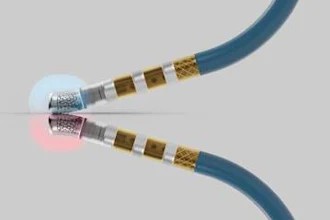
Philips will collaborate with Johns Hopkins University and Boston University as part of the program, combining Philips' expertise in image-guided therapy and workflow automation with academic capabilities in robotics, clinical translation and procedure automation. Johns Hopkins University will be responsible for developing autonomous device navigation, led by Axel Krieger, PhD, Associate Professor in Mechanical Engineering. Boston University will be responsible for developing steerable catheters, co-led by Tommaso Ranzani, PhD, Associate Professor in Mechanical Engineering (ME) and Materials Science & Engineering (MSE); and Sheila Russo Associate Professor in Mechanical Engineering (ME) and Materials Science & Engineering (MSE).