Wearable health monitors are designed to move with the body. But for many devices, movement creates a problem: The more a person bends, stretches, reaches or runs, the harder it can be for the device to keep a stable wireless connection.
Penn State researchers and international collaborators set out to solve that problem by developing a soft, stretchable antenna that can keep working even when pulled in different directions. The work, published in Nature Communications, could help make wearable health monitors more reliable during everyday activity.
“The medical application is the top priority for us, because we see the great potential for this in monitoring human health,” said Huanyu “Larry” Cheng, the James L. Henderson Jr. Memorial Professor of Engineering Science and Mechanics at Penn State and a corresponding author of the study.
The antenna is designed for radiofrequency, or RF, communication, the broad category of wireless technology behind Bluetooth, Wi-Fi and a variety of sensors including health monitors. Antennas not only transmit information through this wireless technology, but they can also harvest energy via RF to power a sensor or other parts of a monitoring system. Unlike a conventional rigid antenna, the new design can stretch with fabric or skin-like materials while staying close to the frequency it needs to send or receive signals or power.
In tests, the antenna remained stable even when stretched up to 45% in multiple directions. Stretching usually changes the frequency an antenna is tuned to, much like knocking a radio dial and losing the station. The new design kept that change small enough that the antenna continued working reliably.
For Cheng, the work addresses a basic challenge in wearable electronics: Sensors may be stretchable, but their antennas often are not.
“When you stretch a sensor, as long as you don’t break the sensor, it still works,” Cheng said. “But for an antenna, you actually change the resonance frequency because of the way antennas and RF work. Stretching makes the antenna longer, and the resonance frequency becomes smaller.”
That shift matters for wearable devices that rely on steady wireless communication.
“If you design it to work at 2.4 gigahertz, say for a Bluetooth module, and stretching shifts it to a different frequency, then the antenna is detuned from the design frequency,” Cheng said. “You won’t be able to receive that signal or energy.”
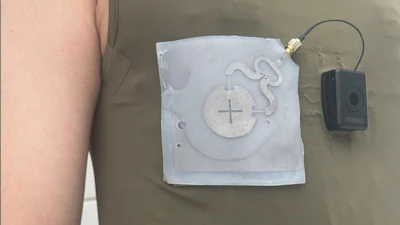
The researchers’ solution was to rethink the shape of the antenna. They built it from tiny liquid metal particles embedded in Ecoflex, a soft, rubber-like material designed to stretch without breaking. They also added a cross-shaped opening in the center of the circular antenna, a key design feature that helps keep wireless signals stable even as the antenna changes shape. When the antenna stretches, the signal path inside the antenna does not simply become longer or shorter. Instead, the slot helps guide that path around the opening, allowing the antenna to compensate for changes in shape.
“If you have a simple circular hole, the antenna can work when it’s stretched in any direction — but you’re losing conductive material, which reduces the antenna’s efficiency,” Senhao Zhang, visiting scholar, engineering science and mechanics doctoral candidate and co-corresponding author, said. “A single slot would preserve more material, but it would only help when the antenna is stretched in certain directions. We had to strike a balance to achieve the best overall performance, which we did with the cross shape.”
Previous stretchable antenna designs have made progress, Cheng said, but many worked best only when stretched in a specific direction — and real bodies do not move that way.
To show that the antenna could work as part of a practical system, including to harvest energy, the researchers tested it in two demonstrations.
In one demonstration, the researchers showed that the antenna could harvest energy from radio waves and convert it into enough electricity to power a small LED light — even while the antenna was stretched by about 30% in different directions. A conventional stretchable antenna, by comparison, lost its ability to provide stable power after being stretched by only about 5%.
“Practical application will require the actual use of the antenna in the sensing and integration of the system,” Cheng said. “Here, the demonstration shows we can get this integrated so the energy can be harvested, and the data can be transmitted.”
In a second demonstration, the researchers used a related version of the antenna for wireless health monitoring. They mounted it on a smart T-shirt with electrocardiogram, or ECG, electrodes and connected it to a Bluetooth Low Energy monitoring system.
The system transmitted stable ECG signals from distances ranging from about 6 feet to more than 300 feet, even after the antenna was stretched.
The system also continued to capture recognizable ECG signals during common movements, including raising an arm and stretching the upper body. In an outdoor test, it recorded ECG, heart rate and acceleration as a volunteer ran from more than 300 feet away toward the receiver.
Based on these results, Cheng said, the most immediate benefits are likely in healthcare. A stretchable antenna that can keep communicating during motion could help wearable monitors track health information more continuously and reliably during daily life, exercise or rehabilitation.
Looking further ahead, Zhang said similar soft RF systems could be useful beyond human wearables, including in flying robots or environmental monitoring systems.
“We’d be very excited to apply this technology to flying robots that could monitor changes in the environment, such as temperature and other environmental conditions,” Zhang said. “That could help us better understand how pollinators like bees and other species are responding to a changing environment.”
The broader goal is not simply to make an antenna stretch, Cheng said. It is to help wearable electronics keep communicating when people move naturally, which can be the moments when continuous monitoring may matter most.
Other authors include Yangbo Yuan, a graduate student in engineering science and mechanics at Penn State. A complete list of authors can be found in the study.